

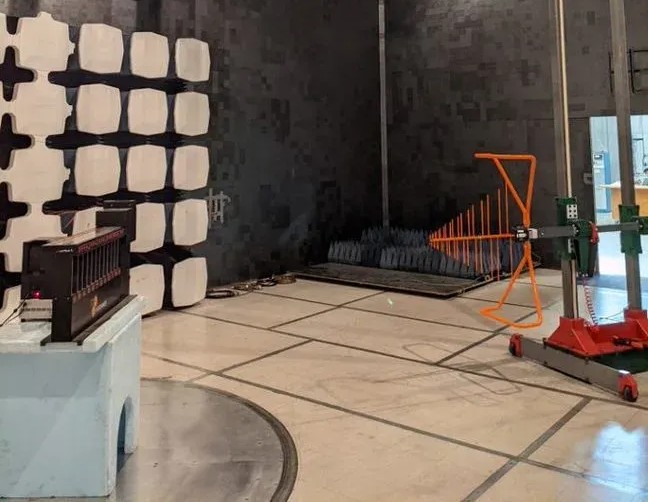
Ah, the many twists and turns in the incredibly circuitous road to establishing a product-based business. It seems so simple on the face of it: make machines to sort and scan Magic and Pokémon cards, then get those machines into the hands of local game store (LGS) staff. Insert rainbow and sunshine emojis here. Wrong. HORRIFYINGLY WRONG! You must now take that product you have developed and navigate your way through the tangled web of intellectual property protection, product safety certification, export declarations, and finally the logistics of delivery. To that end, I spent the first half of last week in and out of an anechoic chamber (borrowing from Wikipedia: “a room designed to completely absorb reflections of either sound or electromagnetic waves”) in pursuit of electromagnetic compatibility (EMC) compliance for our PhyzBatch-9000 card sorting and scanning machine.
“EMC compliance,” you ask, “what the heck is that?”. Great question! Effectively, all electronics produce high frequency radiation. Some devices, like ones that have Bluetooth and Wi-Fi capability, produce radiation signals with the intent of communicating wirelessly to other devices (thereby producing “intentional emissions”), but all electronic devices produce “unintentional emissions”. Unintentional emissions are the high-frequency radiations that are generated simply by dint of electricity passing though the wires and internal circuitry of an electrical device. To prevent unintentional emissions from interfering with other electronics (thereby potentially stopping someone’s pacemaker, knocking-out the navigation system in an airplane, etc.), various jurisdictions have established governing bodies to measure, monitor, and restrict the operation of electronic devices unless they conform to strict standards. In the United States, this job falls to the Federal Communications Commission (FCC), while much of the rest of the world follows the standards set by the International Electrotechnical Commission (IEC).
Riveting stuff, right? Well, exciting or not, compliance with the standards set by these agencies gives an immediate indication for whether or not a device is adhering to the laws governing acceptable standards of emissions. So, if you see FCC or IEC markings on a product, hooray, that product complies with emissions standards. If a product does not have these markings, perhaps think twice before turning it on next to any of your other electronics… or your grandparents… or on an airplane.
What did any of this have to do with sorting trading cards? NOTHING! This had nothing to do with sorting cards, but it was one of the many hoops that we needed to jump through on our way to product delivery. I am very happy to report that our product passed the FCC emissions tests, so our machines are now cleared for operation in the US.
As an aside, I actually found all of this stuff fascinating and purchased a portable spectrum analyzer for the office so that we can perform in-house emissions testing. Then again, it takes a special kind of nerd to devote their professional life to the full-time development of trading card sorting machines, so this may be unsurprising.
The literal and graphical information presented on this site about Magic: The Gathering, including card images, the mana symbols, and Oracle text, is copyright Wizards of the Coast, LLC, a subsidiary of Hasbro, Inc. TCG Machines is not produced by, endorsed by, supported by, or affiliated with Wizards of the Coast.


