

Full transparency: I used Microsoft Copilot’s “Visual Creator” AI tool to generate the image for this post. I had a great deal of fun writing the prompts which resulted in the final picture. What a time to be alive!
I recently came across a thread on Reddit discussing the automatic card sorters currently available on the market. There were the usual series of comments and allegations consisting of: (1) how ludicrously expensive the existing options are; (2) how charging a monthly fee for a card sorter is a clear case of rent seeking; and (3) how the development of a trading card sorting machine is trivially simple. This has become boilerplate to me, as I regularly scan the web to see if there are any new developments in the trading card automation space. Occasionally, I will weigh-in on these threads and provide what I believe to be relevant insight, as I did in the above example – admittedly, a little late to the party. However, my position as a representative of one of “the predatory big 3 machines” (someone actually referred to us this way – I’m looking at you, MotleyMoney) tends to undermine my credibility as an objective participant in the discussion.
So, in the spirit of not wasting any more time trying to convince people of how difficult an undertaking the creation of a commercial trading card scanning machine really is, I have decided to let the public record make my argument for me. Below, you will find a list detailing the credible – or at least semi-credible – attempts made over the decades (yes that’s right, decades) to develop a robotic card sorter. Behold! In chronological order, a list of more than 50 trading card sorting robot projects I have encountered since I started keeping track back in 2015:
[1] JonPaul Laskis ended up launching a business for aftermarket attachments for Ricoh scanners.
[2] TCGplayer, way back in April 2017, had a YouTube video showcasing their own in-house developed card scanning solution which used a Fujitsu scanner. There were several comments from early-adopters about cards having marks left on them by the scanner, and shortly thereafter TCGplayer removed all evidence of the project.
[3] Davide Tampellini pivoted away from using a robotic arm and eventually developed the gantry-style Magic-Sorter, commercially launching that product in 2019 – second to market after the Roca Sorter.
[4] Roca Robotics commercially launched the Roca Sorter in 2018 (first to market), before the founders sold the product line in 2019. Then the Roca Sorter product was acquired by TCGplayer in 2021. Then TCGplayer was acquired by eBay in 2022. Hot potato!
[5] CardCastle commercially launched the CardBot in 2020, becoming the third robot to market.
[6] Back in 2021 these guys threatened to sue us for patent infringement. I had to spend weeks of my life (over the Christmas holiday, no less) writing an extensive report outlining how their patent, due to an overwhelming body of prior art (as exemplified in this post), was unenforceable and should never have been granted in the first place. I cannot overstate how much of a massive waste of time and money this was, and at a very precarious early stage for TCG Machines.
[7] Magicsort’s Magidex Sort Bot was originally intended to be a fully open source card sorting machine project, but their website has since been taken down.
[8] TCG Machines’ PhyzBatch-9000, that’s us! Fourth commercial entry into the market and still going strong 🙂
[9] Jack Baumgartel has a wonderful series of YouTube videos detailing the development of his TC Sifter machine. Sadly, there have not been any updates in over a year.
[10] MTech’s Super Sorter technically launched in 2023, but I do not believe they have yet produced a fully functional prototype, so I’m hesitant to call this one in "production”. Originally branded as the SyncTech Super Sorter, MTech had a rather dramatic, bordering on Shakespearean, falling out with TCGSync, a UK-based company which was originally partnered with them to develop the card recognition software for their machine.
[11] Nexdecks’ Decksray is relatively new, and appears to be very similar to the CardBot, but without a rejection bin? The video is of a very polished looking product, so we’ll see what comes of this.
I must apologize, as several of the links are now broken due to the original content having been removed or made private, but I have indicated these with a “(broken link)” text under the Developer column.
This list is by no means an exhaustive or complete one. I am personally aware of several more projects that never bothered with a public-facing post, so one can reasonably assume there are actually hundreds, perhaps even thousands, of projects that have been initiated in this domain. But, as I only have access to posts made publicly, all I can do is offer insights on what I can link to (i.e. the above). It’s probably informative to note that only 8% of the projects from the above list successfully commercialized and are actively in production, and none have done so since 2021.
But enough with the doom and gloom, I am not intending for this post to dissuade anyone from pursuing their dreams! What I am hoping to accomplish here is to edify the prospective card sorter developer with some brute facts at the outset of their endeavour, so that they may appreciate what they’re up against upfront instead of several years into their toil. Here are those facts:
Still interested? Impressive, and all the power to you! The last warning I’ll provide here is that all the necessary development is expensive, both in terms of time and money. If you aren’t already exceedingly wealthy, you’d better have a very understanding and gainfully employed friend, partner, or spouse to see you through. As one anecdotal point of reference, I started designing a sorting machine in early 2015 while still working full-time as an engineer. I was able to get to a proof-of-concept prototype in early 2016 (see below, photo of me taken April 16th, 2016, after successfully “sorting” a Magic card into an output bin. So young. So full of optimism and ambition), and in September 2016, I decided to pursue the robot sorter full-time.
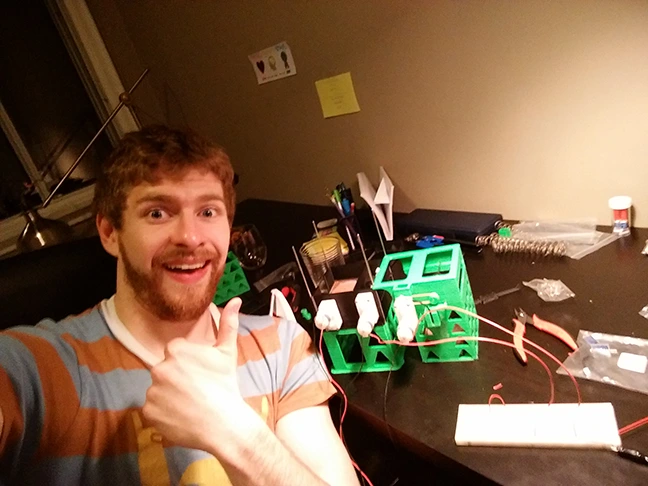
I greatly enjoy reading my business plan from that time period, as, like so many others on the above list, I was overly idealistic (probably the correct term here is “delusional”, but I’ll be generous 😛). In my original break-even analysis, I predicted “conservative sales of 390 units over the first eight months following product launch.” If you have not yet laughed yourself out of your chair, the additional punchline is that the sale price for my machine was going to be just $300… Canadian. As a reality check here: it took five years working full-time on the PhyzBatch-9000 before TCG Machines was even able to launch commercially, and another year still until I was able to draw a salary from the venture; we are now more than three years past our launch and we still haven’t shipped out 390 machines; and lastly, that originally targeted sale price of $300 [CAD] ended up being off by two orders of magnitude… and in the wrong currency.
Alright, that’s enough from me. I hope everyone has a wonderful end to their year as we head into the holiday season for 2024. From all of us here at TCG Machines, happy holidays and Happy New Year!
The literal and graphical information presented on this site about Magic: The Gathering, including card images, the mana symbols, and Oracle text, is copyright Wizards of the Coast, LLC, a subsidiary of Hasbro, Inc. TCG Machines is not produced by, endorsed by, supported by, or affiliated with Wizards of the Coast.


